From a request to a comparison
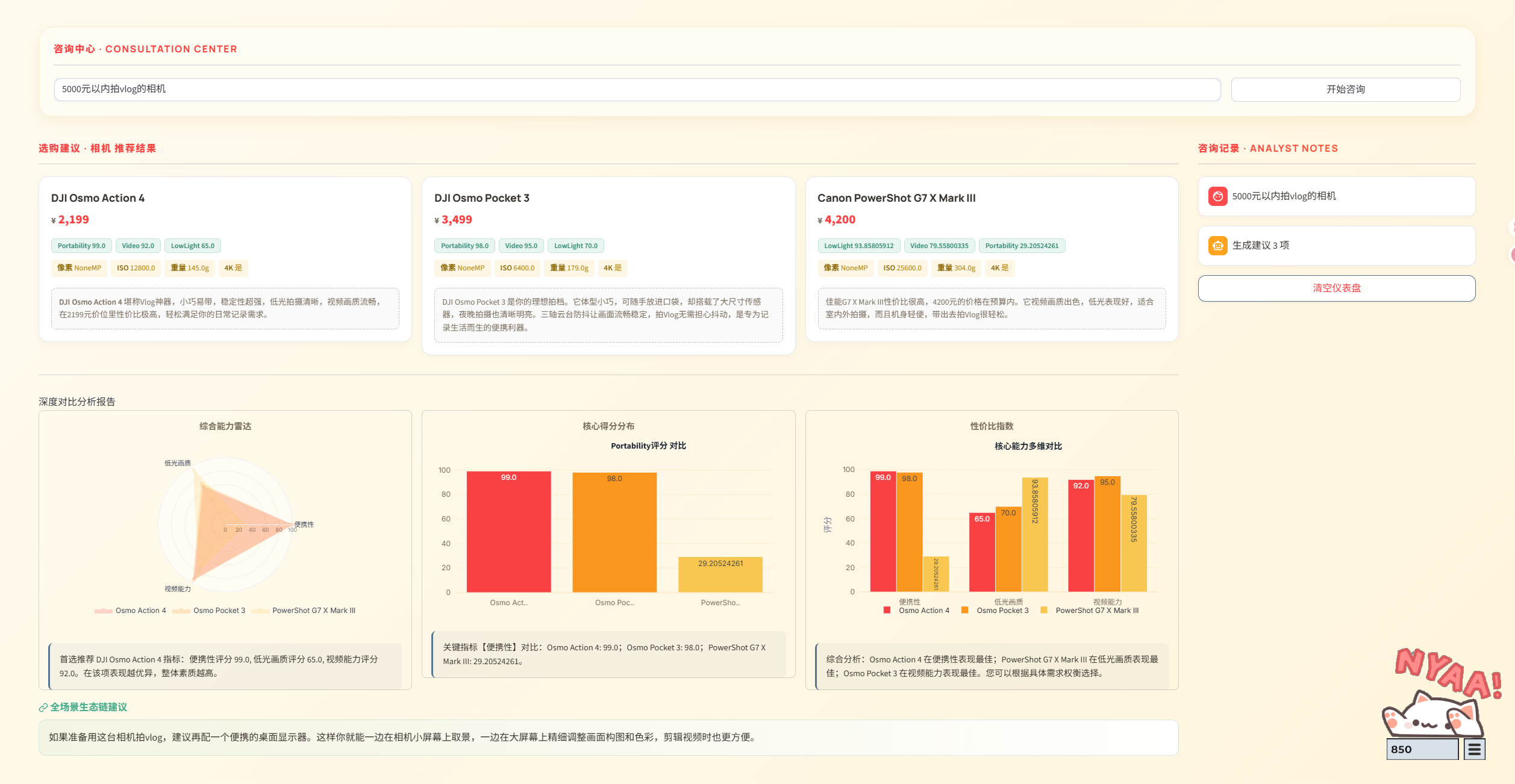
Agent-Powered Product Comparison is a graduation-design prototype for turning natural-language shopping requests into grounded, comparable choices. It pairs language-model intent parsing with a local SQLite fact layer, category-specific rules, and Plotly charts in a Streamlit interface, so a request such as “a Vlog camera under ¥5,000” can become a traceable comparison rather than an ungrounded answer.
My role
- Defined the product concept and the four-layer architecture spanning presentation, intent routing, domain decisions, and fact data.
- Built the Python and Streamlit prototype, including multi-agent routing, category-specific scoring and retrieval, explanatory recommendation cards, and Plotly comparison views.
- Structured a three-level taxonomy across 10 digital-product categories and designed scenario-based rules for product comparison and cross-category suggestions.
- Evaluated the prototype with automated functional checks and a small user-experience study; the local test environment recorded 100% preset-category recognition and 3–5 second end-to-end responses.
Recommendation flow
-
01 / INTERPRET
Understand the request
Category routing and domain agents extract product type, budget, use scenario, brand preference, and ranking priorities from everyday language.
-
02 / RETRIEVE
Ground the comparison
Scenario presets retrieve candidates first; a constrained local-database search provides a fallback when strict requirements leave too few results.
-
03 / EXPLAIN
Make trade-offs legible
Cards, a decision trace, and comparison charts surface the constraints, sorting basis, and multidimensional differences behind each result.
The prototype covers 10 digital-product categories. Its evaluation combines automated logic checks with a small local user-experience study; feedback suggested that conversational input paired with visual comparison made results easier to understand and assess.
Scope and limits
Recommendations are grounded in the project’s local product database rather than live price or inventory feeds. The interface is an academic and portfolio prototype, not a current shopping service.